Transfer Market Analysis: Understanding Transfers and Squads
A transfer is more than a fee - it's a real-time snapshot of career trajectory, squad planning, and football's economic logic. Here's how to read the dynamics behind it properly.
What a Market Value Actually Represents
Football market values are not transfer fees. They are not wages. They are not calculated by a single algorithm issued from a governing body. Instead, a market value is an estimated price - the sum that a player could reasonably command on the open transfer market given their current form, age, contract situation, and a dozen other factors.
The most widely cited source is Transfermarkt, the German football data platform launched in 2000 that has become the global reference for player valuations. What makes Transfermarkt unusual is that it relies heavily on community crowdsourcing: a network of experienced volunteer editors - many of them deeply embedded in club fanbases and scouting communities - update player values based on a structured methodology. These editors assess performance, compare similar players, and adjust values following significant events. The result is a system that combines statistical signals with human judgment at scale.
Other methodologies also exist. CIES Football Observatory, a Swiss research centre, produces algorithmic valuations based on contract length, age, position, performance metrics, and international exposure. Club Elo ratings feed into some models. Transfer fee databases from completed deals provide calibration benchmarks. No two methodologies agree exactly - but they tend to converge around the same order of magnitude for most players.
The key insight is that market values are not facts. They are structured estimates, reflecting the collective best guess of a market that does not always behave rationally. Understanding this distinction is the first step to using valuation data intelligently.
How Market Values Are Determined
Beneath the headline number lies a complex weighting of inputs. Whether you are using Transfermarkt, CIES, or an internal club model, the same core variables appear repeatedly.
Age and Career Stage
Age is arguably the single most powerful variable. Market values follow a predictable arc for most positions: they rise through a player's late teens and early twenties as potential is confirmed by performance, reach their peak somewhere between ages 24 and 27, then decline as the years remaining in a top-level career shorten.
The decline is not just about performance - it is about economics. A 28-year-old and a 23-year-old with identical current performance levels are not equally valuable transfer targets, because the 23-year-old offers five additional peak years of resale potential. Clubs buying players are not just buying what they can do now - they are buying future performance and future resale value. This is why young talent commands such extraordinary premiums.
Contract Length
A player with three years remaining on their deal is worth significantly more than an identical player with six months left. The reason is straightforward: contract length determines how much leverage the selling club retains. When a contract runs down, the player can walk for free at the end - meaning the buying club pays nothing, but the selling club receives nothing either. As the expiry date approaches, the 'market value' in a practical sense converges toward zero, even if the player's actual footballing quality remains unchanged.
This creates one of football's great inefficiencies. Players in the final year of contracts are often available at steep discounts - or for free - even when their performance data remains strong. Identifying these situations is a core part of modern data-driven recruitment.
Performance and Statistics
Recent form and underlying metrics drive short-term value fluctuations. Goals, assists, and clean sheets are the most immediate signals - visible, easily understood, and directly tied to match outcomes. But sophisticated valuation models increasingly incorporate advanced metrics: xG contributions, pressing intensity, progressive passes, duel win rates, and positional heatmaps.
A striker scoring well but with poor underlying xG numbers may be overperforming - their value is inflated by a hot streak unlikely to sustain. Conversely, a midfielder with exceptional progressive passing numbers and high ball-recovery rates may be undervalued by a market still fixated on goal contributions. This gap between observable outputs and underlying quality is precisely where data-informed analysis finds its edge.
League, Club, and Exposure
Playing in a top five European league dramatically increases a player's market value relative to comparable performance in a lower-tier competition - even controlling for age and statistics. This reflects demand-side reality: major clubs and their scouts focus disproportionately on the Premier League, La Liga, Bundesliga, Serie A, and Ligue 1. A striker scoring 18 goals in the Portuguese Primeira Liga will be valued lower than a striker scoring 15 goals in the Premier League, despite the higher raw output.
International exposure compounds this effect. A player capped regularly by a major footballing nation - England, Germany, France, Brazil, Argentina - carries a visibility premium. The Champions League similarly inflates value: playing well on Europe's biggest club stage shifts global perception and generates interest from clubs that might otherwise not be watching.
MatchAnalyzr: Keep Squads in View
The team-squad-rotation widget in MatchAnalyzr shows the current squad of every watchlist team - positions, shirt numbers, injury status, and playing time. Squad shifts between seasons are immediately visible instead of buried in transfer rumour pages.
Market Value vs. Actual Transfer Fee
One of the most persistent misconceptions in football is that market value and transfer fee are the same number. They are not - and the gap can be enormous in both directions.
Transfer fees are negotiated prices, shaped by desperation, leverage, competition, and timing. A club selling a player to a single interested buyer has no leverage; a club with multiple bidders can drive the price above any reasonable valuation. The classic bidding war - Kylian Mbappé attracting Real Madrid and PSG, Harry Kane drawing interest from Bayern Munich and Manchester United - inflates the final fee beyond what any algorithmic model would suggest.
Conversely, fees collapse when clubs need immediate liquidity. Financial Fair Play pressures, ownership changes, or simple cash flow requirements can force sales at fractions of assessed market value. Clubs in financial distress have sold players widely considered to be worth €50m for €25m because the alternative was not selling at all.
The Neymar transfer in 2017 illustrates the extreme end of this dynamic. His €222m move from Barcelona to Paris Saint-Germain didn't just set a world transfer record - it effectively devalued every comparative reference point in the market. Clubs reassessed their own valuations upward across the board. A winger who might have commanded €60m suddenly had agents citing the Neymar fee as evidence of underselling. Transfer market inflation is a real phenomenon, and individual blockbuster deals ripple outward through the entire pricing landscape for years afterward.
The Age-Value Curve: Peak Market Value by Position
While age 25-27 represents the general peak of market value for most outfield players, position matters significantly. The career arc differs meaningfully across roles.
Goalkeepers: The Late Bloomers
Goalkeepers are unique in football economics. They routinely maintain high performance levels well into their mid-thirties, and their market values reflect this extended peak. A top goalkeeper at 30 may still command significant fees - Manuel Neuer, Jan Oblak, and Marc-André ter Stegen held substantial valuations deep into their thirties. The trade-off is that young goalkeepers command lower relative values: a 19-year-old striker with potential is worth far more than a 19-year-old goalkeeper, because the path to starting-level performance is longer and less predictable for keepers.
Historically, goalkeepers have also been undervalued relative to outfield players across all ages, despite their central importance to results. The market has begun to correct this - Alisson, Ederson, and Kepa's fees in the late 2010s represented genuine market reassessment - but a structural discount for the position still exists.
Strikers and Attacking Midfielders: The Premium Position
Goal-scorers attract the highest market values, period. The direct link between goals and match outcomes means that elite strikers at their peak - ages 23-27 - command fees that dwarf comparable profiles in other positions. Erling Haaland's €60m Bosman-clause fee from Borussia Dortmund to Manchester City was widely regarded as an extreme bargain precisely because goalscoring talent of that calibre is so rare and so expensively priced.
The decline curve for strikers is also steeper than for other positions. A striker at 32 may still score, but clubs are rarely willing to pay significant fees for them - the risk-return calculation shifts unfavorably. This creates interesting transfer market opportunities: experienced strikers in their early thirties can represent genuine value for clubs whose model prioritises winning now over asset growth.
Centre-Backs and Defensive Midfielders: The Slow Burn
Defensive players tend to peak slightly later than attackers - ages 26-29 - and maintain their values more steadily through the early thirties. Experience and reading of the game become more valuable at the back, and the physical demands are somewhat less extreme than for wingers or pressing forwards. A 30-year-old centre-back who has proven themselves at the highest level is a far more reliable commodity than a 30-year-old winger trying to maintain the pace that made them valuable at 24.
How Injuries Impact Market Value
Few variables move a player's market value faster than a serious injury. The mechanics are simple: injury reduces expected future output, extends the period before the player can contribute, and introduces uncertainty about whether the player will return to their previous level. For younger players with high valuations based partly on potential, injuries are especially damaging.
The severity and type of injury matters enormously. A broken metatarsal causing a six-week absence will have minimal long-term impact - the market absorbs short absences with little reaction. An anterior cruciate ligament (ACL) rupture is a fundamentally different proposition. ACL injuries typically require 9-12 months of rehabilitation, and historically around 25-30% of elite players never quite return to their pre-injury performance level. The uncertainty drives immediate market value cuts of 20-40% for major players.
Recurrence risk compounds the problem. A player who has suffered one ACL injury is statistically more likely to suffer another. Markets price this in aggressively. Mohamed Salah's extraordinary resilience and near-complete injury avoidance throughout his career has helped maintain his value well into his early thirties - a direct outcome of his physical durability record.
For squad-level analysis, injury history patterns can reveal hidden risk in high-value squads. A team with three key players on long-term injury lists is not just losing matches - it is losing asset value in real time.
Squad Value Analysis: Market Value and League Position
When you aggregate individual market values across a squad, something interesting emerges: total squad value is a reasonably strong predictor of league position over time, though the relationship is noisy enough to be exploited.
In most European leagues, the correlation between squad market value and final league standing is significant - somewhere between 0.6 and 0.8, depending on the methodology used. The biggest clubs win the most, roughly in proportion to their resource advantage. This is the expected order of things in football economics.
But the noise is where the analysis gets interesting. Brighton & Hove Albion in the early 2020s consistently outperformed their squad valuation - finishing in the top half of the Premier League with resources that ought to have produced a mid-table side. Their data-driven recruitment approach identified undervalued players systematically. Conversely, clubs like Everton and Wolverhampton Wanderers periodically assembled squads whose market values implied a top-six finish, only to deliver lower-table results - a signal that value alone does not guarantee performance.
Analysing the gap between expected and actual league position, relative to squad value, is a powerful tool for evaluating coaching quality and club organisation.
MatchAnalyzr: Career Trajectory over Price Tags
On the player detail page you'll find each player's club-by-club, season-by-season career history: clubs, leagues, minutes, and outputs. On the dashboard the `player.player-role` widget shows the current-season role (position, shirt number, captain status, playing-time share) - revealing development patterns that a bare market value could never capture.
Using Market Values for Scouting and Recruitment
The most sophisticated use of market value data is not tracking the most expensive players - it is finding players whose statistical output exceeds their current valuation.
Identifying Undervalued Players
A player producing 0.45 non-penalty expected goals per 90 minutes in the Danish Superliga but valued at €3m is potentially offering €15m-level output at a €3m price - if those underlying numbers translate to a higher-level league. This is exactly the kind of comparison that clubs like Brentford FC, RC Lens, and RB Leipzig built their scouting models around. The challenge is estimating the performance discount from a lower league to a higher one - what analysts call the 'league adjustment factor'.
Geographical and cultural pockets of market inefficiency exist and persist over time. South American leagues, the Austrian Bundesliga, the Belgian Pro League, and the Portuguese Primeira Liga have historically produced players whose value relative to actual quality was significantly lower than in the top five European leagues. Clubs with the scouting infrastructure to evaluate players in these markets consistently ahead of broader market consensus build genuine competitive advantage.
The Free Transfer Paradox
Players available on free transfers are listed with a market value of zero - but they are emphatically not worthless. The 'price' of zero reflects only the transfer fee; the actual cost includes wages (often significantly higher than for comparable players bought at fair market value), signing bonuses, and agent fees that can be substantial. Liverpool's signing of Sadio Mané from Southampton in 2016 for €34m now looks like a bargain - but several players of similar quality have been available for free and gone underappreciated precisely because the absence of a fee made clubs undervalue the asset.
The zero-fee label can also work in a club's favour. Players on free transfers tend to generate less competition, since many clubs associate the absence of a fee with reduced quality. A player whose contract expires because their club could not afford a renewal - common in mid-tier leagues - may be exactly as good as they were the year before. The market value of zero is a contractual fact, not a quality assessment.
Market Value Inflation: The Neymar Effect and Beyond
The football transfer market has undergone sustained inflation over the past two decades. A player valued at €50m in 2010 would need to be valued at around €120-150m today to occupy the same relative position in the market hierarchy. Some of this reflects general economic growth and expanding broadcast revenues - Premier League clubs alone now share over £2.5 billion annually from domestic TV rights alone. Some of it reflects genuine financial irrationality.
The Neymar transfer in August 2017 - €222m from Barcelona to PSG - is the most cited single rupture point. But the inflation was already well underway. Paul Pogba's £89m move to Manchester United in 2016 doubled the world record at the time. Gareth Bale's £85m move to Real Madrid in 2013 had done the same thing three years earlier. Each record-breaking deal recalibrated expectations across the market.
Post-Neymar, clubs began quoting numbers that would have seemed absurd a decade earlier. Players who once would have moved for €60-70m were suddenly priced at €120-150m by their clubs, using Neymar as a reference point. The Premier League's financial dominance - driven by global media rights and commercial revenue - has further distorted the European market, as English clubs can outbid competitors for the same player while still maintaining financial stability.
For the analyst, this inflation has an important practical implication: historical market values are not directly comparable to current ones. A player who was valued at €30m in 2015 occupied a fundamentally different position in the market than a €30m player today. Relative position within a given year's market, rather than absolute numbers, is a more meaningful comparison when analysing across time periods.
MatchAnalyzr: Performance, not Price
The strongest analysis pairs career context with detail stats. Use the career history on the player detail page together with the `player.offensive-stats` widget to check whether a player sustains their level after a transfer - or whether they simply benefited from a weaker environment. The `player.team-impact` widget adds the team-success differential (PPG with/without the player).
Frequently Asked Questions
Who decides a player's market value on Transfermarkt?
Transfermarkt uses a network of experienced volunteer editors who update valuations based on structured criteria: recent performance, contract situation, age, comparable transfers, and media visibility. The process combines community crowdsourcing with editorial oversight, producing values that the football world - including professional clubs and agents - treats as credible reference points even though they are not set by any official body.
Why is a player's market value sometimes much lower than their transfer fee?
Transfer fees are negotiated under real-world conditions that valuation models cannot fully capture: bidding wars between multiple clubs, a selling club's negotiating leverage, time pressure in a transfer window, and individual clauses. A club that holds the only player fitting a very specific profile can demand far above assessed market value. Conversely, financial distress can force sales well below it.
At what age do football players typically reach their peak market value?
For most outfield positions, peak market value falls between ages 24 and 27. Goalkeepers peak somewhat later, often around 27-30, and maintain their values more steadily into the mid-thirties. Wingers and forwards tend to peak earliest and decline fastest, while centre-backs and defensive midfielders hold their values longer. Contract length interacts strongly with age: a 26-year-old on a long contract is valued significantly higher than the same player in their final year.
How much does an ACL injury typically reduce a player's market value?
A serious ACL injury typically causes an immediate market value reduction of 20-40% for high-profile players, depending on age, previous injury history, and the player's recovery timeline. The market discounts uncertainty about full recovery and the statistical recurrence risk. Players who return and sustain their pre-injury performance often see their value recover within 12-18 months. Younger players generally recover value more fully than veterans.
Can market value data be used to identify undervalued players?
Yes - comparing a player's statistical output against their market value is one of the foundational tools in data-driven scouting. Players in smaller leagues who produce elite underlying metrics (xG contributions, progressive carries, defensive actions) but carry lower valuations due to reduced exposure represent potential value opportunities. The challenge is estimating how well those numbers will translate to a higher-level competition - the so-called 'league adjustment' problem that serious recruitment models spend significant effort solving.
Your football.
Your analysis data.
Your dashboards.
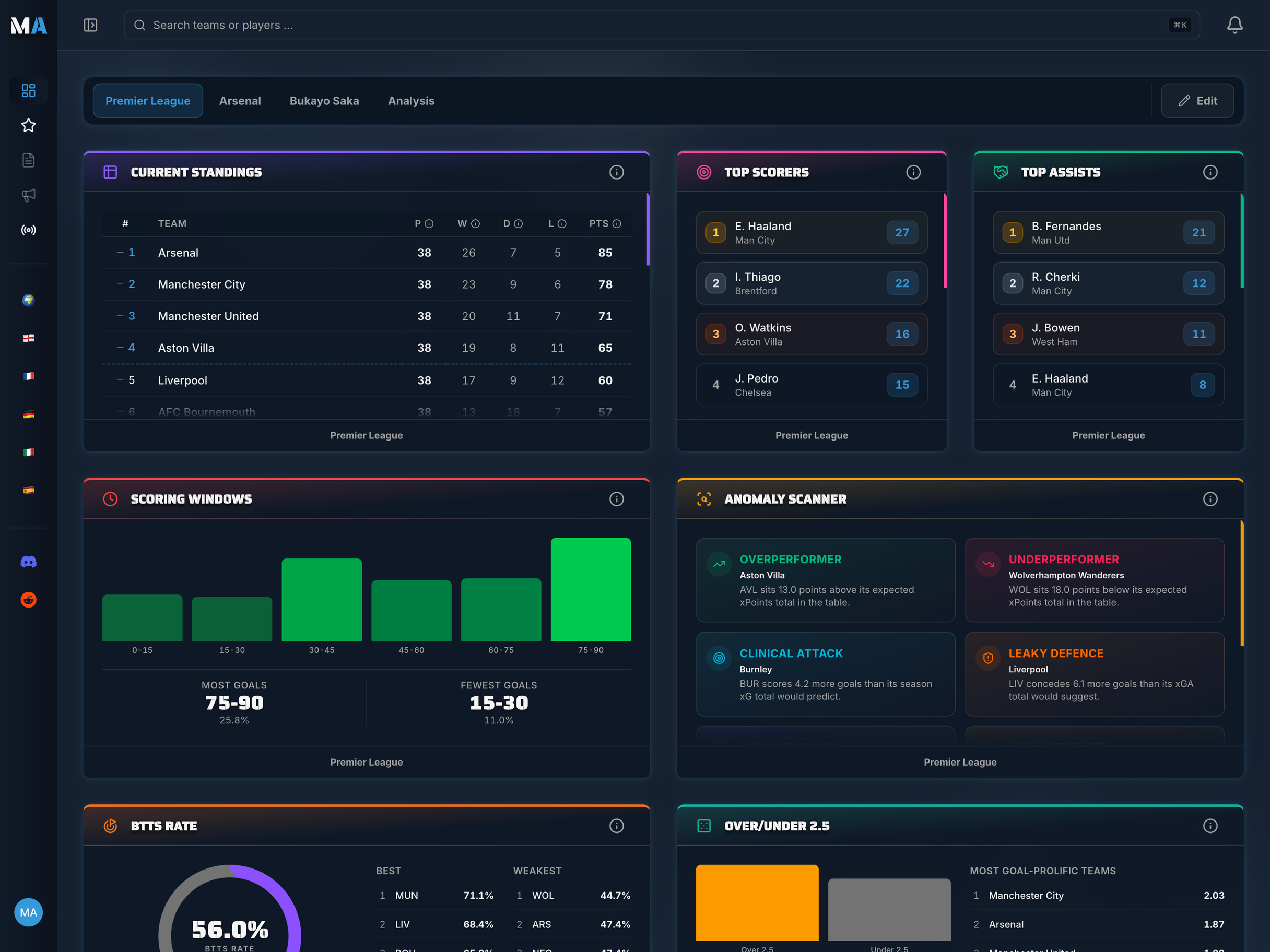
Turn raw data into real insights with MatchAnalyzr. Build your own personalised football dashboard with the leagues, teams and players you actually follow.