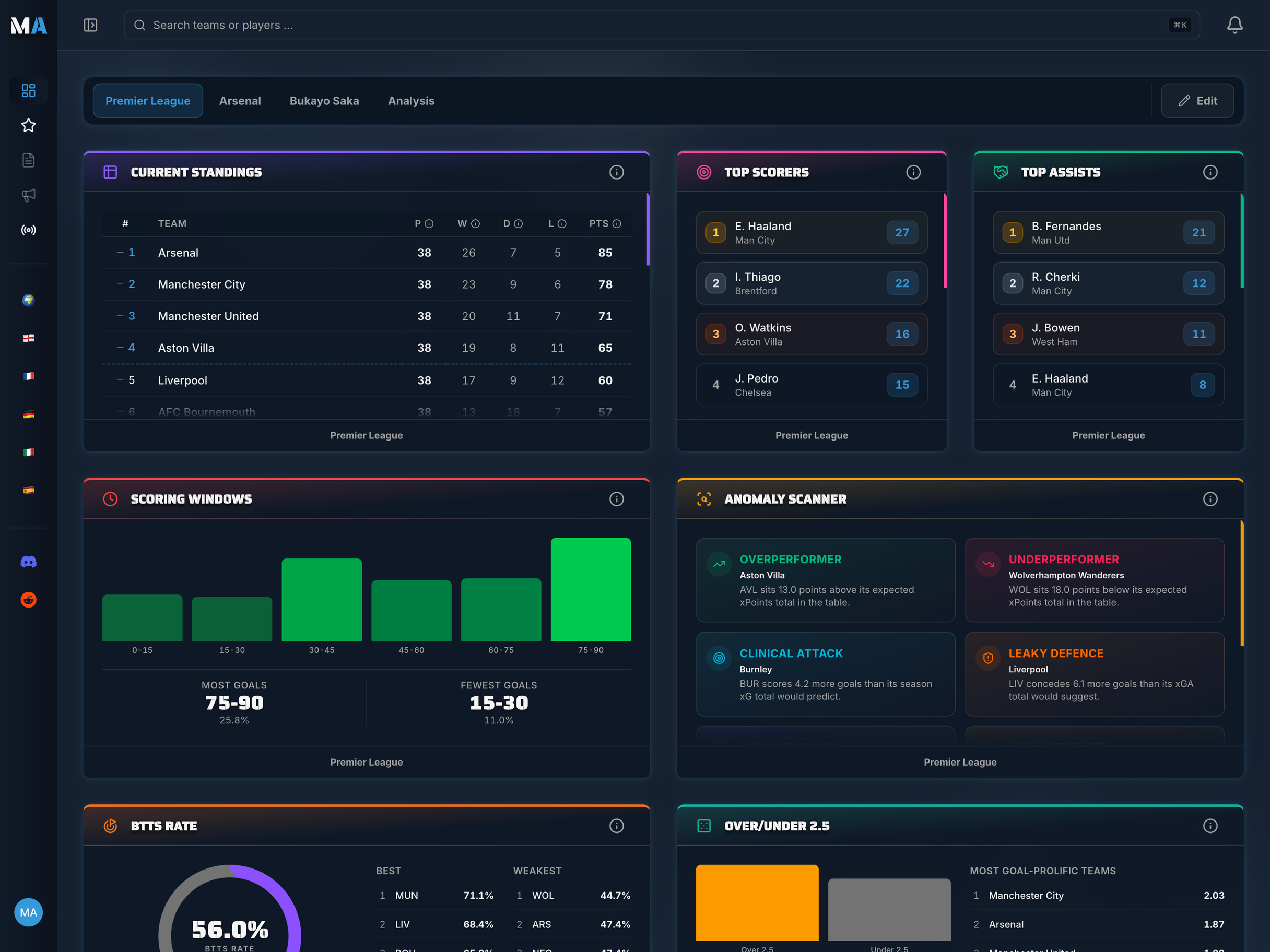
Why the last five games tell you more about a team than the previous six months - and how to use that knowledge for predictions, Fantasy Football, and real match understanding.
What Does "Form" Actually Mean in Football?
Everyone knows the saying: "Form is temporary, class is permanent." True? Mostly. But for short-term assessment - the next match day, this weekend's game - current form is often a more reliable indicator than the league table or a club's general reputation.
In football analytics, "form" typically refers to a team's results over the last five to ten games. This short lookback window filters out what is happening right now, regardless of what went on back in August. A team sitting 12th in the table can be on the best run in the league. Conversely, a table-topping side might have lost four of their last five.
The classic format you see everywhere is five letters: **W-D-L-W-W** (Win, Draw, Loss). Read left to right, old to new - or the other way around, depending on the tool. In MatchAnalyzr, your watchlist teams' last five results appear as colour-coded badges with scores and opponents directly in the Team Form widget. One glance and you know exactly where a team stands right now.
MatchAnalyzr: Team Form at a Glance
The Team Form widget shows your last five results for each watchlist team as colour-coded W/D/L badges - with score, opponent, and home or away context. Up to five teams displayed in slides. See instantly which of your teams is running hot and which is struggling - without opening five different websites.
Why Current Form Matters More Than the Full Table
The league table is an average across months. It captures how good a team has been over the entire season - but it does not show whether they are currently rising or falling. For assessing the next match, that is exactly what you need to know.
Consider a concrete example: Dortmund sit fourth but have lost their last four games. Their opponent on Saturday sits ninth but has won five in a row. Who is the favourite? The table says Dortmund. Form analysis paints a very different picture.
Current form reflects several present realities:
- **Injuries and suspensions**: If the starting centre-back is out, that shows up in form - not in the overall table.
- **Managerial impact or crisis**: A new manager often brings a short-term performance boost. Or a sacking destabilises the squad.
- **Team morale and confidence**: Nothing spreads faster in football than confidence - in both directions.
- **Tactical shifts**: Has a team changed system? That is visible in the last few games, not in season-long aggregates.
The full table has its place, of course. It reflects long-term quality and is the right tool for title races, relegation battles, and European spots. For the next match day, current form is simply more actionable.
The Optimal Form Window: Five Games vs. Ten Games
The big debate: how many games should you look at for form analysis? Five or ten?
**Five games** is the standard window used by ESPN, Opta, and most football media. Short enough to capture current momentum, long enough to smooth out random results. A team performing consistently across five games is likely at that level right now.
**Ten games** filters out outliers more effectively. If a team lost three matches through individual errors or bad luck, the ten-game window reflects underlying quality better. The trade-off is that it reacts more slowly to genuine trend reversals.
The answer depends on the question:
- For match predictions and Fantasy: **five games**, because you are planning short-term
- For transfer scouting or deeper analysis: **ten games**, because you are looking for structural trends
- For in-play betting and ultra-short-term reads: the last **two to three games** can be enough
MatchAnalyzr's MA-Score takes a smarter approach: it weights recent games using exponential decay - more recent matches count more than older ones. This is statistically more robust than a simple flat average window.
Reading Form Curves: Beyond W, D, and L
Wins and losses are the start of form analysis, not the end. Going deeper means looking at:
**Goal difference in the form phase**: A team on W-W-W can still look unconvincing if those wins were all 1-0 against relegation sides. Another team on D-L-D might have played three top-six opponents and actually had the better xG numbers throughout.
**Opponent-adjusted form**: This is the most important nuance. Three wins against bottom-half teams are worth less than one win against a direct rival. Serious form analysis adjusts for opponent quality - either manually or through metrics like adjusted expected goals.
**Shot patterns**: Is a team winning the shot share (shooting more, conceding fewer chances)? Then the form is probably sustainable. Are they winning mainly through an overperforming goalkeeper or unusual finishing efficiency? Regression may be coming.
**Home and away split in form**: Some teams have three home wins and three away defeats. If the next game is away, that dramatically changes the picture painted by their combined form record.
MatchAnalyzr's Team Form widget shows you the W/D/L sequence with scores and opponent names for up to five watchlist teams side by side - so you can assess home-away patterns and opponent quality without switching between five browser tabs.
Visualising Form Curves: Waves, Not Tables
A visualisation says more than a list. Picture a curve where every win moves up, every loss moves down, and a draw stays flat. That waveform immediately shows whether a team is on an upward trajectory - or spiralling.
Even more revealing: a curve that tracks not just results but expected goals per game. A team can be struggling on points but consistently generating good chances - a sign that results will follow performance soon.
MatchAnalyzr's League Momentum widget does exactly this for the entire league: a heatmap of the last six match days shows at a glance which teams are rising and which are falling. Teams in the red zone deserve attention - whether you are betting against them or they are on your Fantasy roster.
MatchAnalyzr: League Momentum Widget
The League Momentum widget displays a form heatmap for the entire league across the last six match days. Dark green means strong form, dark red means poor form. One view reveals which teams are climbing and which are falling - ideal for prediction games and Fantasy decisions that require a league-wide perspective.
Player Form vs. Team Form - Different Dynamics
Many people conflate team form with player form. They follow different rules.
**Team form** is a collective phenomenon. It depends on tactics, squad composition, fixture schedule, and momentum. A team can post good results despite weak individual performances if the system is working.
**Player form** is more individual and more volatile. A striker who has scored four goals in five games is in form - but is it sustainable? Checking their xG (Expected Goals) over that same window tells you whether they are genuinely converting quality chances or running above their expected conversion rate. The latter often does not last.
For Fantasy Football, player form is especially relevant - but also especially dangerous to misread. The last three goals might have been lucky finishes. Look for:
- **Minutes per action** (shots, key passes, final-third touches)
- **Consistency across the window** - one goal in five games differs from five goals in one game
- **Upcoming fixtures** - excellent individual form means little against elite defences
MatchAnalyzr's Player Form widget shows your watchlist players' last five appearances with goals, assists, and minutes - compact and easy to compare across multiple players at once.
Momentum and Psychology: The Invisible Factor
Football is not pure mathematics. Momentum is real - even if it is hard to quantify.
A team that has won five straight games enters the sixth game differently from one that has lost three in a row. Confidence shapes risk-taking, pressing intensity, decision speed in the final third. Sports psychology research consistently shows: teams in positive form phases tend to collaborate more effectively, commit to the crucial final step more often, and come from behind more frequently.
Losing streaks breed anxiety in the opposite direction. Players shoot worse, defend more tentatively, and lose themselves to self-doubt. The word "crisis" in football is not dramatic overstatement - teams in genuine form slumps routinely underperform their statistical expected output.
**Historical examples:**
- **Arsenal's Invincibles 2003/04**: 49 games unbeaten. That was class and form united - and momentum at its absolute peak.
- **Leicester City 2015/16**: By December they had taken 19 of 21 available points. Anyone reading the momentum pattern saw a team in total flow - and a possible title winner.
- **Bayern Munich 2020 Champions League**: 11 games, 11 wins, 43 goals, 8 conceded. Form in its most extreme expression.
MatchAnalyzr: MA-Score and the Form Dimension
MatchAnalyzr's MA-Score weights recent games using exponential decay: more recent results count more heavily than older ones (λ=0.1). This makes the form component of the MA-Score more robust than a simple flat average window. The form dimension accounts for 15% of the total score - combined with xG trends, defensive stability, and additional metrics.
Using Form for Match Predictions: Practical Steps
You rarely win prediction games on gut instinct alone - but also rarely through pure table analysis. Form analysis is the missing piece.
**Step 1: Compare current form of both teams**
Look at the last five games for both sides. Who has more wins? Who has the better goal difference in that window? Who has played stiffer competition?
**Step 2: Adjust for opponent quality**
Three wins against relegation candidates are less meaningful than one win against a Champions League side. Quickly check who the victories came against.
**Step 3: Check home and away form separately**
Some teams are lions at home and lambs away. If the match is away from home, that changes the form assessment considerably.
**Step 4: Factor in current injury and suspension news**
Form is based on past games - but if three regular starters are missing, that past form has limited predictive value for the next match.
**Step 5: Cross-check with xG**
Why did the team win their last three games? Because they played well - or because the goalkeeper was extraordinary? The latter is not repeatable.
For match predictions, combining form with opponent quality, home advantage, and team news is the most robust approach an informed fan can take without specialist statistical software.
Using Form for Fantasy Football: Picking Right
In Fantasy Football, you live and die by weekly transfer decisions. Form analysis is your safety net.
**Captain choice**: Pick your captain based on current form plus upcoming fixture - not reputation. A midfielder in blistering form facing a weak opponent is usually the better pick over a world-class striker in a form slump against a top defensive side.
**Spotting attackers**: Strikers in form - identifiable by goals, shots on target, and Expected Goals across the last five games - have a genuinely higher probability of scoring in the next game. No guarantees, but a statistically grounded edge.
**Defensive picks**: Goalkeepers and defenders are cleanly picked based on team form. A side that has kept three clean sheets is probably tactically stable - great for bonus points.
**Watch the form cliff**: Players who suddenly appear on your radar because they scored three goals in two games are often over-owned and over-priced. Check whether the form is structural (consistent across five games) or whether one standout match against a weak opponent is distorting the picture.
When Form Misleads: Pitfalls of Form Analysis
Form is a powerful tool - but not an infallible one. There are clear situations where it leads you astray.
**Regression to the mean**: Statistically, extreme form sequences normalise. A team that has won seven straight is statistically more likely to underperform in the next few games than during the streak - simply because seven consecutive wins rarely happen without an element of luck.
**Fixture-schedule effect**: Five wins against bottom-half teams say little about performance against top sides. Always check the quality of the fixtures included in the form window.
**International breaks**: After international breaks, recent form is nearly irrelevant - teams return out of rhythm, players come back fatigued from long trips.
**Cup games in the form sequence**: Has the team's form been built against weak cup opponents? It counts, but it needs context.
**New manager effect**: A new manager often generates a short-term performance spike - the "dead cat bounce" of football. Early positive form under a new coach is frequently not sustained.
Form analysis is strongest when used as part of a complete picture - not as a standalone indicator.
Frequently Asked Questions
How many games count for form analysis?
The standard window is five games - short enough to capture current trends, long enough to reduce the impact of individual outliers. For deeper structural analysis, ten games is preferable. For short-term prediction and Fantasy decisions, five games is the optimal window.
Is form or table position more important for predictions?
For the next match day, current form is usually more relevant than table position. Table position reflects long-term quality across the full season - form shows where a team is right now. For precise predictions, combine both: table position as a quality benchmark, form as the short-term directional indicator.
Why does a team lose despite good form?
Form does not guarantee results. Opponent quality, individual mistakes, referee decisions, injuries, and day-to-day variance all play a role. Additionally, extreme form sequences tend to regress - a team on seven straight wins is statistically more likely to drop points soon, simply because sustained streaks always include an element of fortune.
How do I use player form for Fantasy Football?
Look at your candidate's last five appearances: goals, assists, minutes, shots on target. Then assess the upcoming fixture - strong player form against weak opponents is particularly valuable. Also check whether the form is structural (consistent across five games) or whether one exceptional performance against poor opposition is distorting the picture.
What is the difference between momentum and form?
Form is measurable - results, goals, xG values across the last few games. Momentum is the psychological and dynamic component: the confidence, energy, and drive of a team in a positive phase. Form can be captured in numbers; momentum is the invisible multiplier behind those numbers. Together, they explain why some teams in certain phases become almost unstoppable.
Your football.
Your analysis data.
Your dashboards.
Turn raw data into real insights with MatchAnalyzr. Build your own personalised football dashboard with the leagues, teams and players you actually follow.